When people think about wildlife in Sebangau National Park, they usually think of orangutans moving through the canopy, proboscis monkeys along the rivers, hornbills flying above the forest, or kingfishers waiting over the blackwater.
But Sebangau has another world of life that is much smaller and much easier to overlook.
Look down.
After rain, the forest floor, fallen branches and decaying wood can reveal an incredible variety of fungi.
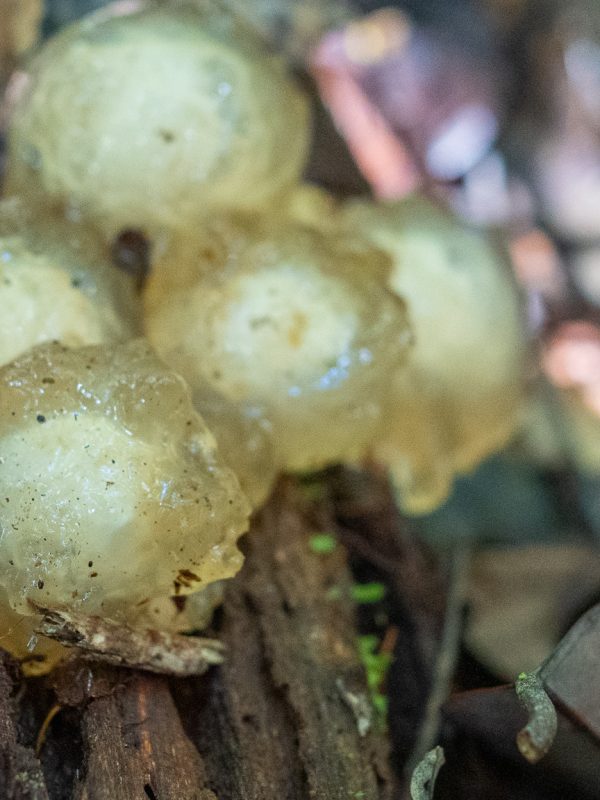
One of them is kulat mata pelanduk, a local name recorded for Tremella encephala in research conducted in the Punggualas area of Sebangau National Park. In more recent taxonomy, the species is also known as Naematelia encephala. (e-journal.upr.ac.id)
For visitors interested in nature, fungi or the smaller details of tropical rainforest ecosystems, this unusual mushroom offers another way of understanding Sebangau.
It is a reminder that there is far more life in the forest than the animals we normally come to see.
What Is Kulat Mata Pelanduk?
Kulat mata pelanduk is a type of jelly fungus.
Unlike the familiar mushrooms with a cap and stem, jelly fungi can have soft, gelatinous and sometimes translucent fruiting bodies.
Their appearance can be surprisingly unusual.
Instead of looking like the mushrooms we commonly see in photographs or markets, they can resemble small clusters of soft, irregular shapes growing directly from wood.
When wet, their texture can become particularly noticeable, with a soft and jelly-like appearance.
In research from Sebangau, the species was identified as Tremella encephala. Modern taxonomic databases currently place the species under the name Naematelia encephala, with Tremella encephala retained as a previous name or synonym. (ncbi.nlm.nih.gov)
Kulat Mata Pelanduk in Sebangau
What makes this mushroom especially interesting for Sebangau is that it has actually been recorded by researchers inside the national park.
A study of macrofungi at the Punggualas Research Station documented Tremella encephala and recorded its local name as kulat mata pelanduk. The researchers found it growing on dead wood within the peat-swamp forest. (e-journal.upr.ac.id)
The same research recorded 28 species of macrofungi from eight families in its study area.
That means kulat mata pelanduk is not simply an interesting local name.
It is part of the documented fungal diversity of the Sebangau peat-swamp forest.
Where Does It Grow?
In Punggualas, kulat mata pelanduk was recorded growing on dead wood.
This is an important detail.
In a rainforest, a fallen tree is not simply a dead tree.
Once a tree falls, it becomes part of another ecological process.
Its branches and trunk can provide shelter and food for insects and other organisms. Fungi colonize the wood and help break it down. Over time, the material becomes part of the nutrient cycle of the forest.
A fallen branch can therefore become an entire miniature ecosystem.
This is why, when exploring Sebangau, it is worth paying attention to dead and decaying wood.
Some of the forest’s most interesting life can be found there.
Why Does It Have a Jelly-Like Appearance?
Jelly fungi are different from many of the mushrooms people are familiar with.
Their fruiting bodies contain a high amount of water and have a distinctive structure that allows them to become soft and gelatinous under moist conditions.
When the environment becomes drier, some jelly fungi can shrink and become less noticeable.
This relationship with moisture is particularly interesting in Sebangau.
The national park is a vast peat-swamp ecosystem where water is one of the fundamental forces shaping the landscape.
The Wet Season Is the Best Time to Explore Sebangau
If you want to discover the smaller forms of life in Sebangau, we recommend the wet season as the best time to visit the park.
Rain changes the forest.
Fallen wood becomes wet.
The forest floor becomes more humid.
Moss becomes greener.
And fungi can become much more noticeable.
Research on macrofungi at Punggualas also discusses environmental factors such as moisture and temperature in relation to the presence of fungal fruiting bodies. (e-journal.upr.ac.id)
The wet season is therefore not simply a time when there is more rain.
It is a time when the character of the peat-swamp forest changes.
The Forest After Rain
Walk through Sebangau after a tropical rain and you may begin to notice things that were easy to miss before.
Small mushrooms appear on fallen branches.
Water droplets cover leaves.
Moss becomes brighter.
Insects move through the vegetation.
And decaying wood can suddenly become covered with small forms of life.
This is one of the reasons exploring Sebangau is not always about finding large animals.
Sometimes, you simply have to slow down.
Why Are Fungi Important?
Fungi play an essential role in forest ecosystems.
One of their most important functions is decomposition.
Leaves fall.
Branches break.
Trees eventually die and fall.
All of that organic material has to be broken down and returned to the ecosystem.
Fungi are part of that process.
They help break down organic matter and make nutrients available again within the forest ecosystem.
In other words, a fungus growing on a dead branch is not simply living on something that the forest has discarded.
It is helping the forest process that material.
The dead tree becomes part of the next cycle of life.
Fungi Are Not Plants
There is another interesting fact about mushrooms.
Although fungi are often associated with plants, fungi are not plants.
They belong to their own biological kingdom: Fungi.
Unlike green plants, fungi do not contain chlorophyll and do not obtain energy through photosynthesis.
Instead, they obtain nutrients from organic material or through relationships with other organisms.
This makes fungi fundamentally different from the trees and plants surrounding them.
And in a tropical rainforest, their diversity can be extraordinary.
The Story Behind the Name “Mata Pelanduk”
The name kulat mata pelanduk is a local name used for this fungus in Central Kalimantan.
Local names are an interesting part of understanding the natural world.
People who live close to forests often develop their own ways of recognizing plants, animals and fungi.
They may identify an organism based on its appearance, where it grows, when it appears or how it has traditionally been used.
In the Punggualas research, the name kulat mata pelanduk was specifically recorded for Tremella encephala. (e-journal.upr.ac.id)
This is a good example of how local knowledge and scientific research can complement each other.
Science provides classification and documentation.
Local communities provide names and knowledge developed through generations of interaction with the forest.
Together, they give us a richer understanding of the species.
Can Kulat Mata Pelanduk Be Eaten?
This is a question that naturally comes up whenever people discover an unfamiliar mushroom.
Research from the Punggualas area lists Tremella encephala among fungi traditionally regarded as edible in the local context. (e-journal.upr.ac.id)
However, this should not be interpreted as an invitation for visitors to collect and eat wild mushrooms.
Identifying fungi can be difficult, and a local name alone is not enough to establish whether an individual specimen is safe to consume.
For visitors, the best approach is simple:
Look at it. Photograph it. Leave it where it grows.
The forest is better with its fungi left in place.
Don’t Just Look for Orangutans
Sebangau is famous for orangutans.
And for good reason.
But if we only look for orangutans, we see only one small part of the ecosystem.
Look more closely and another world appears.
Birds move through the canopy.
Insects live among the leaves.
Frogs hide near wet vegetation.
Moss covers fallen trees.
And fungi grow quietly on decaying wood.
Everything is part of the same forest.
Kulat mata pelanduk reminds us that biodiversity is not always large enough to be seen from a distance.
Why Small Discoveries Matter
When people talk about rainforest conservation in Borneo, the conversation often focuses on large and charismatic animals.
Orangutans.
Proboscis monkeys.
Hornbills.
Sun bears.
But a forest cannot function through large animals alone.
An ecosystem is built from countless relationships between organisms.
Fungi are part of those relationships.
They contribute to decomposition.
They interact with plants and other organisms.
They help move nutrients through the ecosystem.
Studying fungi therefore means studying another part of how the forest works.
Sebangau in the Wet Season
There is a reason we consistently recommend the wet season as the best time to visit Sebangau National Park.
The wet season reveals the character of the peat-swamp forest.
Water becomes a stronger presence in the landscape.
The forest becomes intensely green.
Rivers and waterways take on their own character.
And small organisms such as fungi become an especially interesting part of the forest experience.
Kulat mata pelanduk is one example.
It may be tiny compared with the trees around it, but it tells us something important about the environment in which it lives.
A Forest That Never Really Stops
At first glance, Sebangau can appear quiet.
But the forest is never really still.
Something is growing.
Something is decomposing.
Something is feeding.
Something is being eaten.
Something is reproducing.
Something is returning nutrients to the soil.
Kulat mata pelanduk is one small participant in this enormous cycle.
It grows quietly on dead wood, becoming part of the process that turns what was once a living tree into something the forest can use again.
A Different Side of Sebangau
Most visitors arrive in Sebangau looking for something large.
An orangutan in the canopy.
A monkey beside the river.
A hornbill flying overhead.
But spending more time in the forest changes the way you see it.
You start noticing the smaller things.
And once you start looking closely, the forest becomes much more complicated—and much more interesting.
A fallen branch is no longer just a fallen branch.
A wet leaf is no longer just a leaf.
And a small jelly-like fungus growing on dead wood becomes part of a much larger story.
That is the story of kulat mata pelanduk.
Final Thoughts
Kulat mata pelanduk may never become as famous as the orangutans of Sebangau.
It does not have the size, charisma or unmistakable presence of Borneo’s great mammals.
But it represents something equally important.
The forest is made of more than what we can easily see.
The large animals may be what brings us to Sebangau, but the small organisms help make the forest what it is.
Kulat mata pelanduk is one of those organisms.
Recorded in the peat-swamp forest of Punggualas, growing on dead wood and associated with the humid environment of Sebangau, it is a small but fascinating part of the park’s biodiversity.
And if you want to experience this hidden side of Sebangau, the wet season is the time we recommend most.
Come for the orangutans.
Stay curious about everything else.
Because sometimes, the smallest things tell the biggest stories about the forest.