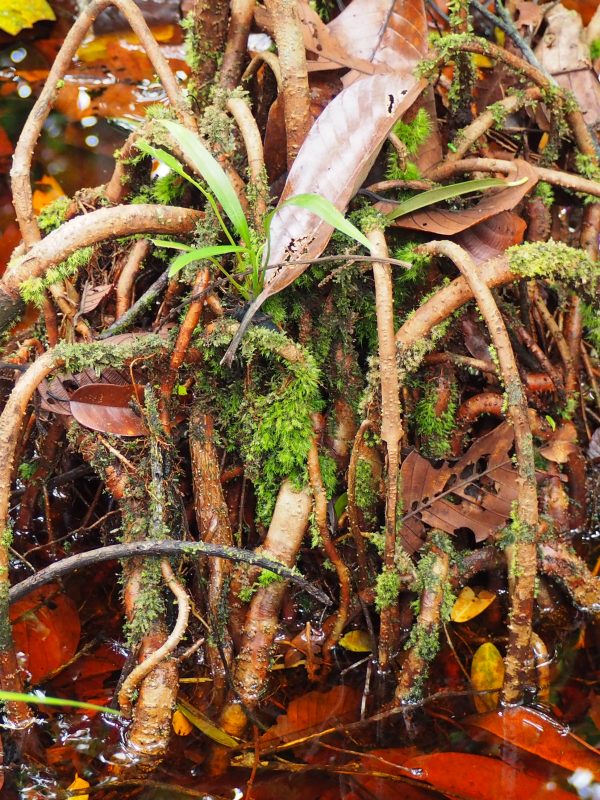
Peatland is one of the most important—and often misunderstood—ecosystems in the tropical regions of Southeast Asia. Covering vast areas of Borneo, Sumatra, and parts of the Malay Peninsula, tropical peatlands store enormous amounts of carbon, regulate water, and provide habitat for some of the world’s most fascinating wildlife.
In Central Kalimantan, peatland is especially important. Much of the landscape around Sebangau National Park consists of tropical peat swamp forest, making the park one of the best places to learn about this unique ecosystem.
But what exactly is peatland, and why is it so important?
Let’s take a closer look.
What Is Peatland?
Peatland is a type of wetland where partially decomposed organic material—mainly plants—accumulates over a long period of time.
In a healthy peatland, the ground remains waterlogged for much of the year. Because there is very little oxygen below the waterlogged surface, dead leaves, roots, branches, and other plant material decompose very slowly.
Over hundreds or thousands of years, this material gradually builds up and forms peat.
In simple terms:
Peatland is a wet landscape where dead plant material accumulates faster than it decomposes.
The peat layer can become several meters thick. In some areas of Borneo, peat deposits reach extraordinary depths.
How Does Peat Form?
Peat formation is a very slow natural process.
It begins with vegetation growing in a wet environment. When plants die, their leaves, branches, roots, and other organic material fall to the ground.
Normally, microorganisms break down this material relatively quickly.
But in a peat swamp, the soil is saturated with water. The lack of oxygen slows decomposition dramatically.
Year after year, more organic material accumulates.
Eventually, layers of partially decomposed vegetation become compressed beneath newer layers. Over thousands of years, these layers develop into thick deposits of peat.
This means that the ground beneath a peat swamp forest is not simply ordinary soil. Much of it consists of ancient organic material that has accumulated over generations of vegetation.
What Does Peatland Look Like?
A tropical peatland can look surprisingly similar to an ordinary rainforest.
You may see tall trees, vines, palms, ferns, pitcher plants, and dense vegetation.
The biggest difference is often beneath your feet.
Instead of mineral-rich soil, the forest may grow on a deep layer of dark, organic peat.
The landscape is also usually very wet. Water can move slowly through the peat and collect in small channels, pools, and rivers.
In Sebangau, visitors traveling by boat can experience this landscape directly. The rivers provide important transportation routes through the peat swamp forest and offer opportunities to observe wildlife along the riverbanks.
Peat Swamp Forest: A Unique Ecosystem
When peatland is covered by natural forest, it forms what is known as a peat swamp forest.
Tropical peat swamp forests are highly specialized ecosystems.
The trees growing here must be able to survive in acidic, nutrient-poor, and waterlogged conditions. Some species have developed unique adaptations to survive in this challenging environment.
The forest may look dense and green, but the ecosystem is relatively fragile.
Changes to the water level, drainage, fire, or land use can have major consequences for the entire system.
Why Is Peatland Important?
Peatlands provide several essential ecological functions.
1. Peatlands Store Huge Amounts of Carbon
One of the most important characteristics of peatland is its ability to store carbon.
Plants absorb carbon dioxide from the atmosphere as they grow. When plants die in a peat swamp, much of their organic material becomes trapped in the waterlogged peat instead of completely decomposing.
Over thousands of years, enormous quantities of carbon can accumulate underground.
This makes tropical peatlands an important part of the global carbon cycle.
When peatlands remain wet and intact, much of this carbon stays stored underground.
When peatlands are drained or burned, however, the stored carbon can be released into the atmosphere.
2. Peatlands Regulate Water
Peat behaves somewhat like a giant natural sponge.
During periods of heavy rainfall, peatlands can absorb and retain large quantities of water.
During drier periods, the stored water can help maintain moisture in the surrounding landscape.
This natural water regulation is one reason why maintaining healthy peatlands is important for the wider ecosystem.
3. Peatlands Provide Wildlife Habitat
Tropical peat swamp forests are home to a remarkable variety of plants and animals.
In Borneo, these forests provide habitat for species including:
- Bornean orangutans
- Proboscis monkeys
- Gibbons
- Hornbills
- Kingfishers
- Crocodiles
- Snakes
- Frogs
- Numerous species of fish and insects
For some species, peat swamp forest is an essential part of their natural habitat.
Sebangau National Park and Its Peatlands
Sebangau National Park is one of the most important examples of tropical peat swamp forest in Indonesia.
Located in Central Kalimantan, the park protects a vast landscape of peat swamp forest between the Katingan and Kahayan river systems.
The park is particularly famous for its orangutan population.
For travelers, however, Sebangau offers something beyond simply seeing orangutans. It provides an opportunity to experience a living peatland ecosystem and understand how water, forest, wildlife, and people are connected.
A journey through Sebangau can involve traveling along blackwater rivers, walking through peat swamp forest, observing wildlife, and learning how local communities interact with the surrounding landscape.
Why Are the Rivers in Peatlands Often Dark?
One of the distinctive features of Borneo’s peat swamp forests is their dark-colored water.
The water may appear brown, reddish, or almost black.
This does not necessarily mean that the water is polluted.
The color is largely caused by tannins and other dissolved organic compounds released as plant material decomposes in the peat.
These substances give many peat swamp rivers their characteristic “blackwater” appearance.
This is why rivers flowing through peat swamp forests can look very different from clear-water rivers found in other parts of Borneo.
Why Is Peatland Vulnerable?
Although peatlands are extremely important, they are also highly sensitive to changes in their natural water system.
One of the biggest threats is drainage.
When drainage canals are constructed, water can leave the peatland more quickly. As the peat dries, it becomes much more vulnerable to fire.
This creates a dangerous cycle:
Drainage → Dry peat → Increased fire risk → Peat degradation → Carbon emissions
Peat fires can be particularly difficult to control because they may burn underground within the peat layer.
A fire that appears to have been extinguished on the surface can sometimes continue smoldering below ground.
Why Peat Fires Are Different
Forest fires in ordinary vegetation can spread across the surface.
Peat fires can behave differently.
Once peat becomes sufficiently dry, fire can penetrate into the organic soil itself. Instead of simply burning leaves and trees, the fire can continue burning through the peat layer.
This makes peat fires difficult to detect and extinguish.
They can also produce large amounts of smoke because enormous quantities of organic material are being burned.
This is one reason why maintaining high water levels in peatlands is such an important part of peatland management.
Can Peatland Be Restored?
Yes.
Peatland restoration focuses on bringing the ecosystem back toward its natural wet condition and allowing vegetation to recover.
One important approach is rewetting.
This can involve blocking or managing drainage canals so that water remains within the peatland for longer periods.
Once the water level is restored, natural vegetation can gradually recover.
Reforestation and protection from further disturbance can also support ecosystem recovery.
However, peatland restoration is a long-term process. A damaged peat ecosystem cannot simply be restored overnight.
Peatland and the Orangutans of Sebangau
The connection between peatland conservation and orangutan conservation is particularly important in Sebangau.
Orangutans depend on healthy forests for food, shelter, and movement.
Protecting the peat swamp forest therefore also protects the habitat of orangutans and countless other species.
This demonstrates an important principle of conservation:
Protecting a species often means protecting the ecosystem that supports it.
When we protect the peatland, we are not only protecting the peat itself. We are protecting the forest, rivers, wildlife, carbon stored underground, and the ecological processes that connect them all.
Experiencing Peatland as a Visitor
For travelers visiting Sebangau National Park, peatland is not just something to read about.
It is something you can experience.
As you travel along the river, you can see the distinctive dark water of the peat swamp ecosystem. Along the riverbanks, dense vegetation creates habitat for birds, monkeys, reptiles, and other wildlife.
Further into the forest, the environment changes again. The ground becomes soft and waterlogged, and the characteristics of peat swamp forest become more apparent.
With a knowledgeable local guide, visitors can learn to recognize different plants, understand how the forest interacts with the river, and appreciate why this ecosystem deserves protection.
Peatland Is More Than Just Wet Soil
It is easy to look at a peat swamp and simply see a wet forest.
But beneath that forest is a much older story.
Layer after layer of vegetation has accumulated over thousands of years, creating a massive natural storehouse of carbon and supporting a complex ecosystem above it.
The rivers carry organic material through the landscape. The forest provides habitat for wildlife. The peat stores water and carbon. Local communities depend on the surrounding environment.
Everything is connected.
That is what makes peatland so fascinating—and why protecting it matters.
Visit the Peat Swamp Forest of Sebangau
Sebangau National Park offers travelers a rare opportunity to experience one of Borneo’s most important ecosystems firsthand.
Instead of thinking of peatland simply as wet ground beneath a forest, visitors can see it as a living ecosystem—one that has developed over thousands of years and supports orangutans, birds, reptiles, plants, rivers, and people.
By visiting responsibly and supporting conservation and local communities, travelers can become part of the effort to protect this remarkable landscape.
The next time you travel through Sebangau’s dark-water rivers, remember: beneath the forest is a world of ancient peat, quietly storing the history of the rainforest.