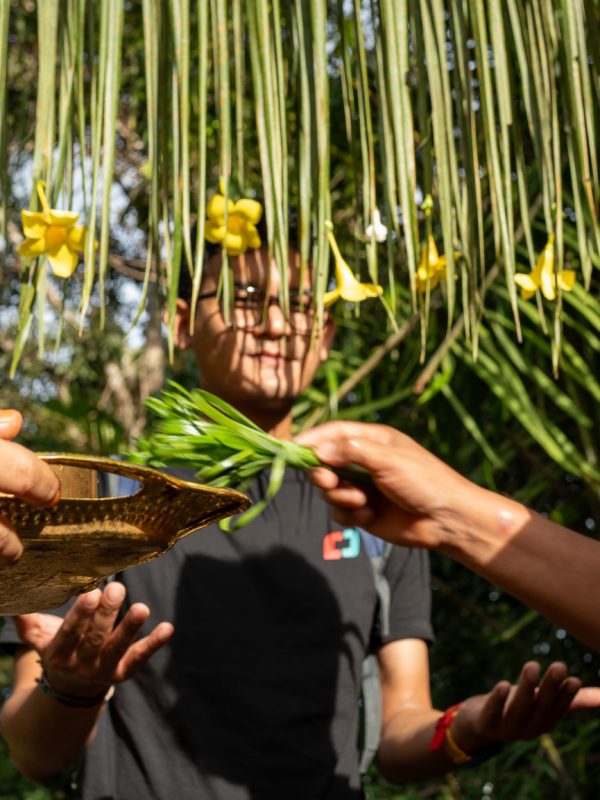
When people hear the word Dayak, they often imagine the forests of Borneo, traditional longhouses, elaborate ornaments, blowpipes, and ancient rituals.
But the Dayak people of Kalimantan are not one single ethnic group. They consist of many different communities, languages, histories, and traditions.
In Central Kalimantan, one of the most important Dayak groups is the Dayak Ngaju.
For visitors exploring Palangka Raya, the Sebangau region, or other parts of Central Kalimantan, learning about the Dayak Ngaju provides a different way of understanding the landscape. The rivers, forests, villages, plants, and even the way communities interact with nature are closely connected to the history and cultural identity of the people who live here.
Who Are the Dayak Ngaju?
The Dayak Ngaju are one of the major Dayak communities of Central Kalimantan. Historically, Ngaju communities developed along the major river systems of the region, including the Kahayan, Kapuas, Katingan, and other waterways.
The river was much more than a route for transportation.
It was a source of food, a place for fishing, a connection between communities, and an important part of everyday life. Villages traditionally developed along rivers, making the landscape of Central Kalimantan inseparable from its people.
The Dayak Ngaju also have their own language, known as Bahasa Dayak Ngaju. The language remains an important part of cultural identity and is still spoken in different parts of Central Kalimantan.
Interestingly, the language also contains a great deal of knowledge about the natural environment. Research into Dayak Ngaju vocabulary has documented how plant names and traditional knowledge are connected to ecology, including medicinal plants and agriculture.
This relationship between language and environment is important when looking at Dayak Ngaju culture.
The forest is not simply a collection of trees.
It is part of a living cultural landscape.
Kaharingan and the Spiritual Connection with Nature
One of the most important elements of traditional Dayak Ngaju culture is Kaharingan, the ancestral belief system of the Ngaju people.
The term Kaharingan is associated with the idea of life or living. For followers of Kaharingan, the natural and spiritual worlds are deeply connected.
The supreme deity is known as Ranying Hatalla Langit.
Traditional stories describe the creation of the universe and the relationship between the upper world, the human world, and the lower world. These ideas are reflected in many aspects of Dayak Ngaju art, rituals, architecture, and symbolism.
Although many Dayak Ngaju people today follow Christianity or Islam, elements of traditional Ngaju culture continue to be visible in everyday life, ceremonies, architecture, art, and local identity.
This is one reason why it is important not to think of Dayak culture as something frozen in the past.
Dayak Ngaju culture continues to change.
Batang Garing: The Tree of Life
One of the most recognizable symbols of Central Kalimantan is the Batang Garing.
You may see its distinctive shape on government buildings, public spaces, cultural monuments, traditional artwork, and other places around Palangka Raya.
Batang Garing is traditionally understood as the Tree of Life in Dayak Ngaju cosmology.
Its symbolism is connected to the relationship between the different realms of existence and the balance between human beings, nature, and the spiritual world.
The symbol is particularly interesting because it has moved beyond its original religious context.
Today, Batang Garing has also become a broader symbol of Dayak Ngaju cultural identity and Central Kalimantan.
So when you see Batang Garing around Palangka Raya, you are not simply looking at a decorative pattern. It carries a much deeper cultural history.
Huma Betang: Living Together Under One Roof
Another important concept in Dayak culture is the Huma Betang, or traditional longhouse.
Historically, the longhouse provided a shared living space for members of a community. More than just an architectural structure, it represented ideas about community, cooperation, mutual respect, and living together.
A Huma Betang could accommodate many families and become a centre of community life.
The philosophy associated with Huma Betang remains relevant even as traditional settlement patterns have changed.
One of the important ideas connected with the Huma Betang is that people from different backgrounds can live together while respecting one another.
For visitors, this provides an opportunity to understand Dayak culture beyond traditional clothing and performances.
The building itself tells a story about how communities were organized.
Tiwah: A Ceremony for the Ancestors
Perhaps one of the most well-known Dayak Ngaju ceremonies is Tiwah.
Tiwah is a traditional funerary ceremony associated with the Kaharingan tradition. It is connected with the final journey of the deceased and the relationship between the living and their ancestors.
The ceremony can involve elaborate preparations and traditional rituals, sometimes bringing together relatives and members of a wider community.
Tiwah is not simply a funeral.
It reflects a worldview in which death is understood as part of a larger spiritual journey.
Because Tiwah is a sacred ceremony, visitors should understand that it is not a cultural performance created for tourism. If travelers ever encounter such an event, respect for the community and its rules is essential.
Not every ceremony is open to outsiders, and photography should never be assumed to be permitted.
Music, Oral Traditions, and Karungut
Culture is not only expressed through buildings and ceremonies.
The Dayak Ngaju also have rich traditions of oral literature and music.
One example is karungut, a traditional form of sung poetry associated with the Dayak Ngaju. Another important tradition is sansana, an oral poetic tradition that can be performed during celebrations, ceremonies, and community gatherings.
These traditions were historically important ways of transmitting stories, values, knowledge, and social memory.
Before modern books, television, and the internet, stories could travel through generations through spoken words, songs, and performances.
This is one reason language preservation is so important for Dayak Ngaju culture.
When a language disappears, it is not only vocabulary that can be lost.
Traditional ecological knowledge, stories, expressions, and ways of understanding the world can disappear with it.
The River and the Forest
To understand Dayak Ngaju culture, it is difficult to separate people from the landscape.
Central Kalimantan is a land of rivers and wetlands. Communities have historically depended on rivers for transportation, fishing, agriculture, and communication.
At the same time, forests provide food, medicine, materials, and other resources.
This relationship can still be seen around the communities surrounding protected areas such as Sebangau National Park.
People living around Sebangau have traditionally depended on the surrounding landscape in different ways, including fishing and other natural-resource-based activities.
Modern conservation therefore cannot simply be about drawing a line around a forest and telling people not to enter it.
People and nature have been connected here for generations.
Today, conservation programs in Sebangau increasingly involve local communities in activities such as ecosystem restoration, tourism, and other forms of sustainable livelihood.
This community involvement is particularly important in a peatland landscape, where maintaining water levels and reducing fire risk are essential for protecting the ecosystem.
Dayak Ngaju and Sebangau National Park
Sebangau National Park is famous for its peat-swamp forest and orangutans.
But there is another story that is just as important.
The forest exists within a larger human landscape.
Communities around Sebangau have their own histories, livelihoods, knowledge, and relationships with the rivers and forests surrounding them.
Several community groups have become involved in tourism and conservation activities around the national park. Official conservation records, for example, document local groups providing guiding, traditional boat transport, food, porter services, and cultural activities for visitors.
This creates an opportunity for tourism to become more than simply a trip into the forest.
A visit can also become an introduction to the people who live around the forest.
For travelers interested in responsible tourism, this connection matters.
The forest is not an isolated wilderness.
It is part of a living landscape.
What Can Travelers Learn From Dayak Ngaju Culture?
You do not need to attend a major traditional ceremony to learn about Dayak Ngaju culture.
Sometimes, the simplest experiences can be the most meaningful.
Talking with a local guide.
Traveling by traditional boat along a river.
Learning the name of a local plant.
Eating local food.
Visiting a village.
Seeing traditional architecture.
Listening to a local story.
Or simply asking how people have traditionally used the surrounding forest.
These small encounters can reveal how closely culture and landscape are connected.
And this is particularly relevant in Sebangau.
A traveler who comes only to see orangutans may leave with photographs of wildlife.
A traveler who takes time to understand the people and landscape may leave with a much broader picture of Borneo.
Respecting Dayak Ngaju Culture as a Visitor
When visiting communities in Central Kalimantan, cultural respect is important.
Here are a few simple principles:
Ask before taking photographs
People, ceremonies, sacred objects, and certain places may have cultural significance. Always ask before photographing people or participating in traditional activities.
Do not treat sacred ceremonies as entertainment
Traditional ceremonies have meaning for the community. They should not automatically be viewed as tourist performances.
Listen to local explanations
Different Dayak communities may have different traditions, languages, and interpretations. A local guide can provide context that cannot be found in a generic description of “Dayak culture.”
Respect local customs
Dress appropriately, follow community rules, and listen to your guide when entering villages or culturally important places.
Support local communities
Choosing local guides, boat operators, food providers, handicrafts, and community-based tourism initiatives can help ensure that tourism benefits the people who live in the destination.
Dayak Ngaju Culture Is Still Alive
It is easy to describe indigenous cultures as if they belong entirely to history.
But the Dayak Ngaju are not a people from a museum.
They are part of contemporary Central Kalimantan.
They live in towns and villages, speak both local and national languages, work in modern professions, use smartphones, run businesses, practice different religions, and participate in modern Indonesian society.
At the same time, traditional symbols, stories, language, ceremonies, values, and relationships with the environment continue to shape cultural identity.
That combination of old and new is what makes Dayak Ngaju culture particularly interesting.
Beyond the Orangutans: Another Side of Sebangau
For many international travelers, Sebangau first appears on the map because of orangutans.
And the orangutans are certainly one of the reasons to visit.
But Sebangau is more than wildlife.
It is a vast peatland landscape shaped by rivers, forests, local communities, conservation efforts, and generations of human interaction with the environment.
Understanding the Dayak Ngaju helps put that landscape into context.
The forest has a story.
The river has a story.
The people have a story.
And they are all connected.
A journey into Sebangau can therefore be more than a search for wildlife. It can also be an opportunity to understand a small part of the cultural landscape of Central Kalimantan and Borneo.
Final Thoughts
The Dayak Ngaju culture is deeply connected to the rivers, forests, and communities of Central Kalimantan.
From the spiritual ideas of Kaharingan and the symbolism of Batang Garing to Huma Betang, traditional music, oral traditions, and the continuing relationship between communities and the forest, Ngaju culture offers another way to understand Borneo.
When you visit Sebangau, look beyond the trees.
Listen to the river.
Talk to the people.
Ask questions.
And remember that the landscape you are exploring is not only a habitat for wildlife. It is also a cultural landscape that has been home to people for generations.
This is one of the many stories that make Sebangau more than just a rainforest destination.