When exploring the waterways and peat-swamp forests of Sebangau National Park, one of the most exciting bird encounters can happen in just a few seconds. A flash of blue, orange, or brilliant green suddenly crosses the river before disappearing into the dense vegetation.
You may have just seen a kingfisher.
Kingfishers are among the most recognizable birds in Southeast Asia, famous for their striking colors, powerful bills, and remarkable ability to hunt from above the water. In Borneo, several species can be encountered in suitable habitats, including rivers, streams, forest edges, and wetlands.
For birdwatchers and wildlife photographers visiting Sebangau National Park, kingfishers are particularly fascinating because they combine beautiful appearances with interesting hunting behavior.
What Is a Kingfisher?
Kingfishers belong to the bird family Alcedinidae and related kingfisher groups, depending on the species. They are generally small to medium-sized birds with relatively large heads, strong pointed bills, and short legs.
Despite their name, not every kingfisher specializes exclusively in catching fish.
Some species hunt fish and other aquatic animals, while others feed on insects, frogs, crustaceans, lizards, and even small mammals. Their diet depends largely on their species and habitat.
One of their most distinctive characteristics is their hunting technique.
A kingfisher often sits quietly on a branch overlooking water or open ground. It may remain almost motionless for several minutes, carefully watching for prey. Then, in a sudden burst of speed, it dives or flies toward its target before returning to a perch.
This combination of patience and explosive movement makes kingfishers fascinating birds to observe.
Kingfishers in Borneo
Borneo is home to a diverse range of kingfishers and kingfisher-like birds.
Some are strongly associated with rivers and wetlands, while others prefer forest environments. Their presence can therefore provide useful clues about the condition and diversity of an ecosystem.
Around the forests and waterways of Sebangau, observers may encounter species such as:
- Blue-eared Kingfisher
- Rufous-backed Kingfisher
- Stork-billed Kingfisher
- Collared Kingfisher
- White-throated Kingfisher
- Other kingfisher species depending on location and season
The exact species encountered will depend on the habitat, water conditions, season, and the particular area being explored.
Blue-eared Kingfisher: A Jewel of the Rainforest
One of the most beautiful kingfishers associated with the lowland forests of Borneo is the Blue-eared Kingfisher (Alcedo meninting).
This small kingfisher has a striking combination of blue and orange coloration. Its brilliant blue plumage can appear almost metallic when sunlight reaches it through the forest canopy.
Unlike some larger kingfishers that are easy to spot from a distance, the Blue-eared Kingfisher can be much more challenging to find.
It often prefers shaded forest streams and quiet waterways, where its colors can blend surprisingly well with the surrounding vegetation.
For photographers, this creates an exciting challenge: spotting the bird is only the beginning.
Stork-billed Kingfisher: The Large Kingfisher
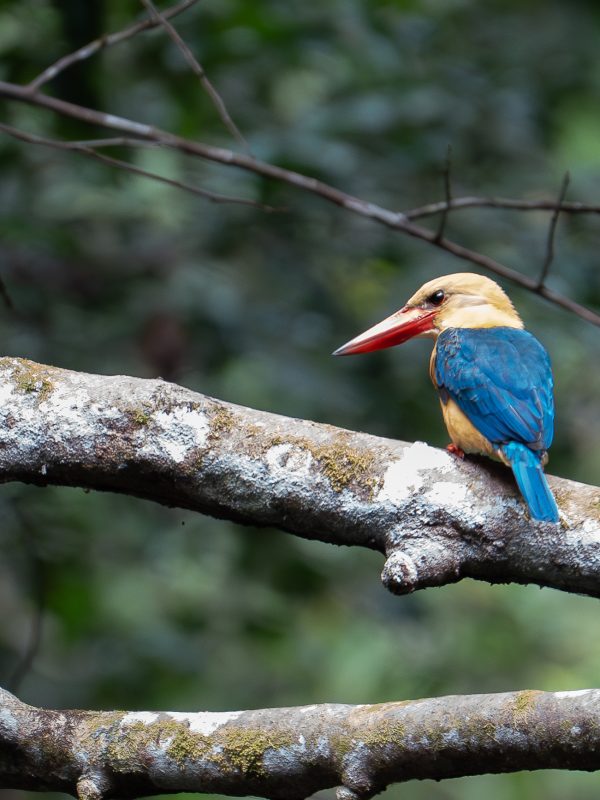
The Stork-billed Kingfisher (Pelargopsis capensis) is one of the largest kingfishers found in Southeast Asia.
It is immediately recognizable by its large red bill, powerful appearance, and combination of blue, brown, and orange coloration.
Compared with smaller kingfishers, the Stork-billed Kingfisher can look almost oversized. Its large bill is particularly impressive and is perfectly adapted for catching a variety of prey.
It can hunt fish, frogs, crabs, reptiles, and other small animals.
Seeing one perched quietly along a riverbank can be an unforgettable wildlife experience.
Collared Kingfisher: A Familiar Coastal and Open-Habitat Species
Another species that visitors to Borneo may encounter is the Collared Kingfisher (Todiramphus chloris).
This kingfisher is generally associated with more open habitats, including coastal areas, mangroves, plantations, gardens, and forest edges.
Its blue-green back, white collar, and strong dark bill make it relatively easy to identify.
Unlike forest specialists, Collared Kingfishers are often comfortable around areas influenced by people, making them one of the kingfishers that visitors may encounter outside deep rainforest habitats as well.
How Do Kingfishers Hunt?
Watching a kingfisher hunt is one of the highlights of birdwatching in Borneo.
The basic strategy is simple but highly effective.
First, the bird chooses a suitable perch.
It may sit on a branch, fallen tree, exposed root, or other elevated position overlooking water or the forest floor.
Then it waits.
And waits.
The bird’s ability to remain still can make it surprisingly difficult to notice.
Once prey is detected, the kingfisher launches itself from the perch. Depending on the species and target, it may plunge into the water or fly directly toward prey on land.
After catching its prey, it often returns to a perch.
Some kingfishers then beat their prey against the branch before swallowing it.
This behavior helps them handle slippery or difficult prey and is particularly fascinating to watch through binoculars or a camera with a long lens.
Why Are Kingfishers Important?
Kingfishers are more than just beautiful birds.
They are predators within the rainforest food web and help regulate populations of aquatic and terrestrial animals.
Because different species occupy different habitats, their presence also contributes to the overall biodiversity of the ecosystem.
A healthy rainforest landscape provides:
- Clean and productive waterways
- Abundant fish and aquatic animals
- Insects and other prey
- Suitable nesting sites
- Trees and branches for hunting
- Dense vegetation for shelter
Protecting the habitat therefore benefits not only kingfishers but thousands of other species living within the ecosystem.
Kingfishers and Sebangau’s Peat-Swamp Forest
Sebangau National Park is particularly interesting for birdwatchers because of its extensive tropical peat-swamp forest.
Peat-swamp forests are unique ecosystems. They develop on waterlogged soils containing large amounts of partially decomposed organic material and support specialized plant and animal communities.
The rivers, channels, blackwater streams, and flooded areas within and around the forest create opportunities for wildlife associated with aquatic environments.
For kingfishers, these waterways can provide both hunting grounds and habitat.
This is one reason that a slow boat journey through the waterways of the Sebangau landscape can be rewarding for birdwatchers.
You never quite know when a kingfisher will appear.
The Best Way to Find Kingfishers
Finding kingfishers requires patience.
Unlike large mammals such as orangutans, they do not necessarily make themselves obvious.
A good approach is to move slowly and pay attention to exposed branches near water.
Look for:
- Branches hanging over streams
- Fallen trees near riverbanks
- Quiet sections of blackwater rivers
- Forest edges
- Openings in dense vegetation
- Areas with small fish or other prey
Listening can also help.
Some kingfishers have distinctive calls that can reveal their presence before the bird itself becomes visible.
An experienced local guide can be particularly valuable because guides who regularly explore the forest may recognize both the calls and favorite perches of local birds.
Photographing Kingfishers in Sebangau
Kingfishers are excellent subjects for wildlife photography, but they can be challenging.
Their sudden movements mean that a fast shutter speed is often useful, particularly when trying to capture flight or diving behavior.
A telephoto lens is also recommended because these birds can remain far away from the boat or trail.
For a perched kingfisher, patience is often more important than equipment.
Instead of approaching the bird aggressively, it is usually better to remain still and allow the bird to continue behaving naturally.
Early morning and late afternoon can provide beautiful light, while overcast conditions can sometimes produce softer colors and reduce harsh highlights on the bird’s plumage.
The goal should always be to photograph the bird without disturbing it.
Kingfisher Watching Is About More Than the Bird
One of the best things about searching for kingfishers in Sebangau is that you rarely spend your entire time looking at one species.
While waiting for a kingfisher to appear, you may notice other birds moving through the canopy, reptiles along the riverbank, insects around the vegetation, or monkeys calling from deeper in the forest.
This is what makes wildlife exploration in Sebangau so rewarding.
The forest is constantly moving.
Sometimes the most memorable encounter is the one you were not expecting.
A Small Bird With a Big Role
Kingfishers may be small compared with the orangutans and other iconic animals of Borneo, but they are an important part of the rainforest ecosystem.
Their colorful appearance makes them popular with photographers, while their hunting behavior provides a fascinating glimpse into the complex food web of tropical wetlands and forests.
For visitors to Sebangau National Park, seeing a kingfisher flash across a blackwater river can become one of those brief wildlife moments that stays in the memory long after the journey is over.
The next time you travel through Sebangau, keep your eyes on the riverbank.
That sudden flash of blue might be a kingfisher.
Frequently Asked Questions About Kingfishers in Sebangau National Park
Are kingfishers found in Sebangau National Park?
Yes. Kingfishers and other kingfisher species can be encountered in suitable habitats within the Sebangau landscape, particularly around waterways, forest edges, and wetland habitats.
What do kingfishers eat?
Their diet varies by species but can include fish, insects, frogs, crustaceans, reptiles, and other small animals.
What is the best time to see kingfishers in Sebangau?
Early morning is generally an excellent time for birdwatching because birds are active and temperatures are cooler. However, kingfishers can potentially be encountered throughout the day.
Are kingfishers difficult to photograph?
They can be. Their small size, fast movements, and tendency to stay at a distance make a telephoto lens and patience very useful.
Do all kingfishers eat fish?
No. Although many kingfishers hunt fish, several species specialize partly or largely in insects, frogs, crustaceans, reptiles, and other prey.
Explore Sebangau National Park
If you are interested in rainforest wildlife, birdwatching, photography, and exploring one of Borneo’s remarkable peat-swamp ecosystems, Sebangau National Park offers an excellent opportunity to experience wildlife in its natural habitat.
Keep your binoculars ready, move slowly, and look carefully along the riverbanks—you never know when one of Borneo’s colorful kingfishers will suddenly appear.