Sebangau National Park is one of the most important wildlife destinations in Central Kalimantan, Indonesia. Located on the island of Borneo, the park protects a vast tropical peat-swamp ecosystem that provides habitat for an extraordinary variety of wildlife.
The park is particularly famous for its Bornean orangutans, but orangutans are far from the only animals living here. Sebangau is home to dozens of mammal species, numerous birds, reptiles, amphibians, fish, and countless insects. Official information from the Indonesian conservation authority lists 65 mammal species, 182 bird species, 46 reptile species, 11 amphibian species, and 72 fish species recorded in the park.
What makes wildlife watching in Sebangau special is the environment itself. Much of the park consists of tropical peat-swamp forest, a unique ecosystem where waterways, flooded forest, tall trees, and dense vegetation create a habitat unlike many other destinations in Borneo.
If you are planning a wildlife trip to Sebangau, here are ten animals you may encounter during your journey.
1. Bornean Orangutan
Scientific name: Pongo pygmaeus wurmbii
The Bornean orangutan is undoubtedly the star of Sebangau National Park.
Sebangau supports one of the most important populations of Bornean orangutans anywhere in the world. The Indonesian Ministry of Environment and Forestry’s conservation authority identifies the Bornean orangutan as one of the park’s key wildlife species and reports that the species is widely distributed throughout the park.
Orangutans spend most of their lives in the forest canopy. They move slowly through the trees, searching for fruit, young leaves, bark, insects, and other food.
Seeing a wild orangutan is very different from seeing one in a zoo or rehabilitation centre. In Sebangau, you are observing an animal living independently in its natural habitat.
You may see an orangutan high in the canopy, feeding on fruit, building a nest, or moving between trees. Sometimes you may only notice movement in the leaves or hear branches breaking above you.
Wildlife sightings can never be guaranteed, which is part of what makes searching for orangutans in the rainforest so exciting.
2. Agile Gibbon
Scientific name: Hylobates agilis / Hylobates albibarbis
Another spectacular primate found in Sebangau is the agile gibbon.
Gibbons are exceptionally adapted to life in the forest canopy. They use their long arms to swing from branch to branch, sometimes travelling rapidly through the treetops.
The gibbon’s call is often easier to detect than the animal itself. Early in the morning, their loud, distinctive songs can travel considerable distances through the forest.
Sebangau is particularly important for gibbon conservation. Research has documented a large population of Bornean agile gibbons in the Sebangau ecosystem, while the national park’s own biodiversity information lists gibbons among its important mammal species.
If you are exploring the forest early in the morning, listen carefully. A distant gibbon call may be your first indication that a family group is nearby.
3. Proboscis Monkey
Scientific name: Nasalis larvatus
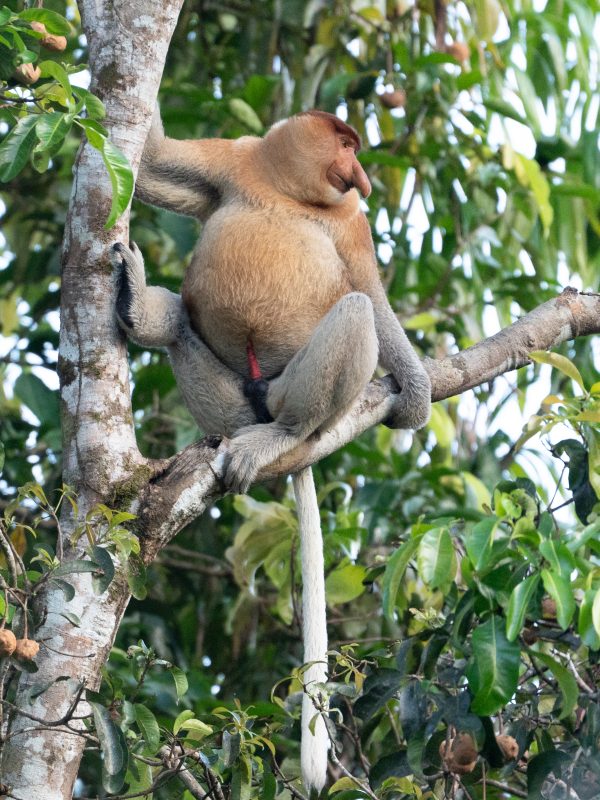
The proboscis monkey, locally known as bekantan, is one of the most distinctive primates in Borneo.
It is easily recognised by its reddish-brown coat, long tail, and, particularly in adult males, its large pendulous nose.
Proboscis monkeys are strongly associated with wetlands, rivers, mangroves, and other lowland habitats. Sebangau’s network of rivers and wetland environments provides suitable habitat for this iconic Bornean species.
The Indonesian conservation authority specifically identifies the proboscis monkey as one of Sebangau National Park’s important wildlife species.
They can sometimes be seen resting in trees along waterways. Early morning and late afternoon can be productive periods for wildlife observation, although sightings depend heavily on location, weather, and animal behaviour.
4. Southern Pig-Tailed Macaque
Scientific name: Macaca nemestrina
The southern pig-tailed macaque, known locally as beruk, is another primate recorded in Sebangau.
Compared with orangutans and gibbons, macaques are generally more terrestrial and may be encountered closer to the forest floor.
They live in social groups and are highly adaptable, feeding on fruits, seeds, leaves, insects, and other available food.
The species is included in the Sebangau National Park fauna records.
If you are walking along forest trails, keep your eyes open not only for animals in the canopy but also for movement on the ground and in lower vegetation.
5. Maroon Leaf Monkey
Scientific name: Presbytis rubicunda
The maroon leaf monkey, sometimes called the red leaf monkey, is another primate that can be found in the forests of Sebangau.
Its reddish or maroon-coloured fur makes it particularly attractive to wildlife photographers.
Like many forest primates, leaf monkeys spend much of their time feeding and moving through the vegetation. Their behaviour can make them surprisingly difficult to photograph, especially when they remain high in the canopy.
The species is listed among the mammals recorded in Sebangau National Park.
For photographers, a group of leaf monkeys moving through the canopy can provide an excellent opportunity to capture the relationship between Bornean wildlife and its forest habitat.
6. Malayan Sun Bear
Scientific name: Helarctos malayanus
The Malayan sun bear is the smallest bear species in the world and one of the more elusive mammals of Borneo.
Sun bears are excellent climbers and spend time searching for fruit, insects, honey, and other food in the forest.
They are not animals that visitors should expect to see regularly. A sighting in the wild is relatively special because sun bears are secretive and often active in areas where dense vegetation makes observation difficult.
The species is officially recorded among the mammals of Sebangau National Park.
If you are lucky enough to encounter one, maintaining a safe distance and allowing the animal to move naturally is essential.
7. Sunda Clouded Leopard
Scientific name: Neofelis diardi
One of the most mysterious predators of Borneo is the Sunda clouded leopard.
This beautiful wild cat has a distinctive cloud-like pattern across its coat and is adapted to life in dense tropical forests.
The clouded leopard is among the most difficult animals to encounter in Sebangau. It is elusive, primarily active at night or during low-light periods, and lives in an environment where dense vegetation makes observation extremely challenging.
Nevertheless, the species is recorded as part of the mammal fauna of Sebangau National Park.
For most visitors, simply knowing that animals such as clouded leopards share the forest adds another dimension to exploring Sebangau.
A wildlife tour in a rainforest is not only about the animals you see. It is also about understanding the hidden biodiversity that exists around you.
8. Binturong
Scientific name: Arctictis binturong
The binturong is one of the more unusual mammals found in Borneo.
Sometimes called a bearcat, the binturong is neither a bear nor a cat. It is a mammal related to the civet family and is recognisable by its dark, shaggy fur and long prehensile tail.
Binturongs are primarily arboreal and can spend considerable time in trees. They are generally difficult to spot because their dark colour blends into the forest and they can remain hidden among branches and foliage.
The species is included in the fauna records of Sebangau National Park.
Because binturongs are relatively elusive, encountering one in the wild can be a memorable highlight for wildlife enthusiasts and photographers.
9. Rhinoceros Hornbill and Other Hornbills
Scientific name: Buceros rhinoceros
Sebangau is not only a destination for mammal watching. Birdwatchers can also find a remarkable variety of birds in the park.
One of the most impressive is the rhinoceros hornbill, a large forest bird with a distinctive casque above its bill.
Hornbills play an important ecological role in tropical forests, particularly in seed dispersal. When they consume fruit and later move through the forest, they can help distribute seeds away from the parent tree.
The official Sebangau National Park biodiversity information records several hornbill species, including rhinoceros hornbills, helmeted hornbills, black hornbills, and other species.
For birdwatchers, the sound of wingbeats moving through the canopy or the call of a hornbill can be just as exciting as spotting a mammal.
Bring binoculars and a suitable telephoto lens if bird photography is part of your Sebangau itinerary.
10. Storm’s Stork and Other Wetland Birds
Scientific name: Ciconia stormi
Sebangau’s wetlands provide habitat for many fascinating bird species, including the relatively rare Storm’s stork.
The park’s official biodiversity records include Storm’s stork among its bird species, together with lesser adjutants, herons, darters, eagles, hornbills, and other birds.
Storm’s stork is associated with wetlands and forest environments and is not a bird that every visitor will see. However, its presence demonstrates the ecological importance of Sebangau’s rivers, wetlands, and peat-swamp forests.
For birdwatchers, exploring Sebangau can therefore provide opportunities beyond the famous orangutan.
Wildlife Watching in Sebangau: What Should You Expect?
One of the most important things to understand before visiting Sebangau National Park is that wildlife sightings are never guaranteed.
This is a genuine rainforest ecosystem rather than a wildlife park. Animals move freely through a huge protected landscape, and their behaviour changes according to weather, food availability, season, and human activity.
You may spend hours looking for an orangutan and see only birds and insects. On another day, you might unexpectedly encounter an orangutan, gibbon, or group of monkeys.
This unpredictability is part of the experience.
Scientific research has recorded dozens of mammal species in Sebangau. One study recorded 46 mammal species, highlighting the importance of the peat-swamp ecosystem for wildlife.
Best Time for Wildlife Watching
Early morning is often an excellent time to explore tropical forests because many animals are active after sunrise.
Morning excursions can be particularly rewarding for birdwatching and listening for gibbon calls.
Late afternoon can also be productive as temperatures become cooler and some animals become more active.
However, there is no single time of day when every species will appear. The best approach is to spend enough time in the forest and allow your guide to identify signs, sounds, movement, and suitable habitats.
Tips for Seeing More Wildlife
If wildlife is your main reason for visiting Sebangau National Park, a few simple practices can make a significant difference:
1. Start early.
Morning excursions provide opportunities to see active birds and primates.
2. Move slowly.
Sudden movements and loud conversations can make animals disappear before you notice them.
3. Listen carefully.
Gibbons, birds, monkeys, and other animals can often be detected by sound before they become visible.
4. Bring binoculars.
Many animals remain high in the canopy, making binoculars extremely useful.
5. Use an appropriate camera lens.
A telephoto lens is particularly useful for wildlife photography because animals may remain far from trails and waterways.
6. Follow your guide’s instructions.
Local guides understand the forest and can help identify animal calls, tracks, feeding signs, and movement.
7. Be patient.
Wildlife watching is about observation rather than chasing animals.
Responsible Wildlife Watching
Sebangau National Park is an important conservation area, and responsible tourism is essential to protecting its wildlife.
Never feed wild animals or attempt to touch them. Avoid making excessive noise and never try to force an animal into a better position for photography.
Keep a respectful distance, follow park regulations, and avoid leaving rubbish behind.
The future of Sebangau’s wildlife depends not only on government protection and conservation organisations but also on responsible visitors and local communities.
Tourism can play a positive role when it supports conservation and provides sustainable opportunities for people living around the national park.
Final Thoughts
Sebangau National Park offers much more than the chance to see an orangutan.
From Bornean orangutans and agile gibbons to proboscis monkeys, leaf monkeys, hornbills, sun bears, clouded leopards, and rare wetland birds, the park supports an extraordinary range of wildlife.
Some animals are relatively easier to encounter, while others are extremely elusive. That uncertainty is what makes a wildlife journey through Sebangau so rewarding.
The park’s real attraction is not simply the number of animals you can see. It is the opportunity to experience wildlife living in one of Borneo’s most important tropical peat-swamp ecosystems.
If you are planning a wildlife adventure in Central Kalimantan, Sebangau National Park deserves a place on your Borneo itinerary.
Ready to explore Sebangau National Park? Join a guided Sebangau wildlife tour and discover the rainforest, rivers, peat-swamp ecosystem, and wildlife of Central Kalimantan with local guides.