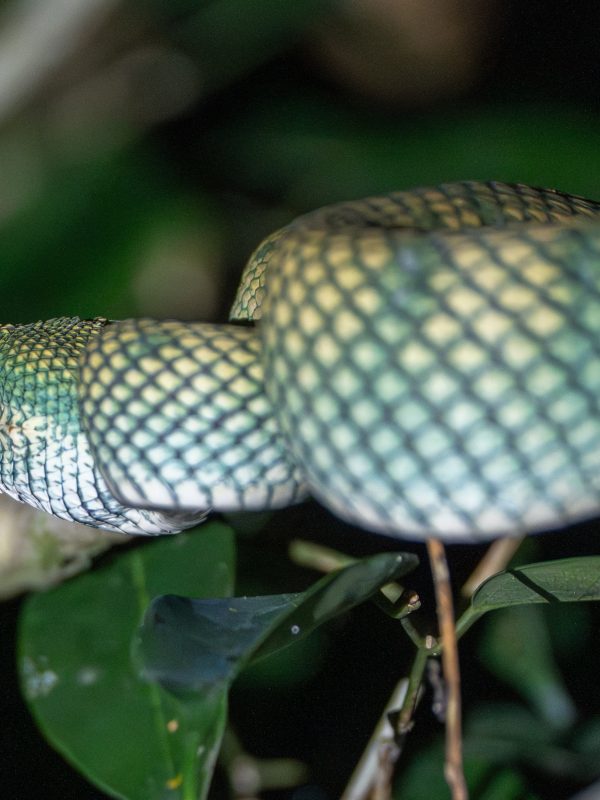
Deep in the tropical forests of Borneo, some of the most fascinating wildlife is not always found on the forest floor. High among branches, vines, and dense vegetation lives a beautifully patterned but venomous predator: the Borneo Pit Viper.
In Sebangau National Park, Central Kalimantan, pit vipers are among the reptiles that visitors may encounter while exploring the rainforest. Their ability to remain motionless for long periods, combined with excellent camouflage and an arboreal lifestyle, makes finding one a memorable experience for wildlife enthusiasts and photographers.
The snake commonly known in Borneo as the Bornean Keeled Pit Viper (Tropidolaemus subannulatus) belongs to the Viperidae family and is closely related to the snakes historically referred to as Wagler’s Pit Viper or Temple Pit Viper. Taxonomic studies have shown that what was once treated as a single widespread Tropidolaemus wagleri complex actually contains several distinct species, with Borneo populations assigned to Tropidolaemus subannulatus.
For travelers visiting Sebangau, spotting one of these snakes is a reminder of just how diverse the Bornean rainforest really is.
What Is the Borneo Pit Viper?
The Borneo Pit Viper is an arboreal venomous snake adapted to life in tropical forests. It belongs to the subfamily Crotalinae, commonly known as pit vipers.
The name “pit viper” comes from a remarkable sensory adaptation. On each side of the snake’s head, between the eye and nostril, is a specialized heat-sensitive pit organ. These organs allow the snake to detect infrared radiation from warm-bodied animals and help it locate prey even when visibility is poor.
This is especially useful for a predator that spends much of its time waiting quietly among branches.
Rather than actively chasing prey through the forest, pit vipers are generally ambush predators. They can remain in one location for extended periods, waiting for a suitable animal to come within striking range. Observations of Tropidolaemussnakes have documented extremely limited movement over several days.
Bornean Keeled Pit Viper Scientific Name
The scientific name currently associated with the Bornean population is:
Bornean Keeled Pit Viper
Scientific name: Tropidolaemus subannulatus
Family: Viperidae
Subfamily: Crotalinae
Genus: Tropidolaemus
The taxonomy of these snakes has changed over time.
For many years, Bornean snakes were commonly identified as Wagler’s Pit Viper (Tropidolaemus wagleri). A major revision of the Tropidolaemus wagleri species complex found that populations from Borneo, Sulawesi, the Sulu Archipelago and the Philippines formed a distinct group corresponding to Tropidolaemus subannulatus.
This is why visitors may encounter different names when searching online.
Older wildlife articles may call the snake Wagler’s Pit Viper, Temple Pit Viper, or simply Wagler’s Pit Viper of Borneo, while more recent taxonomic sources use Bornean Keeled Pit Viper (Tropidolaemus subannulatus).
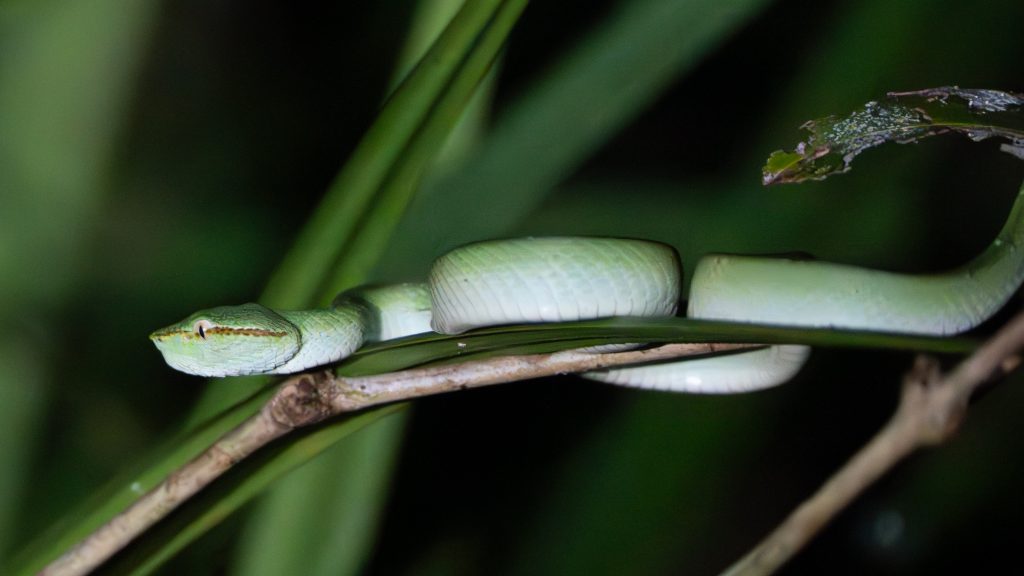
What Does a Borneo Pit Viper Look Like?
One of the most remarkable characteristics of Tropidolaemus pit vipers is their coloration.
They can display striking combinations of green, yellow, black, red, and white. Their patterns vary depending on age, sex, and individual variation.
The snake has several features typical of pit vipers:
- A broad, triangular-shaped head
- Relatively stout body
- Keeled scales
- Heat-sensing pits between the eyes and nostrils
- Strongly keeled scales around parts of the head and throat
- A prehensile tail adapted for climbing
The coloration can also provide excellent camouflage.
A green snake resting among leaves can become surprisingly difficult to see, especially in the complex vegetation of a tropical rainforest.
This is one reason why experienced guides and wildlife researchers can sometimes spot snakes that appear almost invisible to an untrained observer.
Why Is It Called a Pit Viper?
The word “pit” in pit viper does not refer to a hole or pit where the snake lives.
Instead, it refers to the specialized heat-sensing pit organs located on the snake’s face.
These organs detect heat emitted by warm-blooded animals such as birds and mammals. This gives pit vipers an additional sensory system that complements their normal vision and other senses.
For an ambush predator living in a dense rainforest, this adaptation is extremely valuable.
Imagine a small bird moving through vegetation at night. Even when the animal is difficult to see, its body produces heat. The pit viper can detect this thermal information and use it to help locate its potential prey.
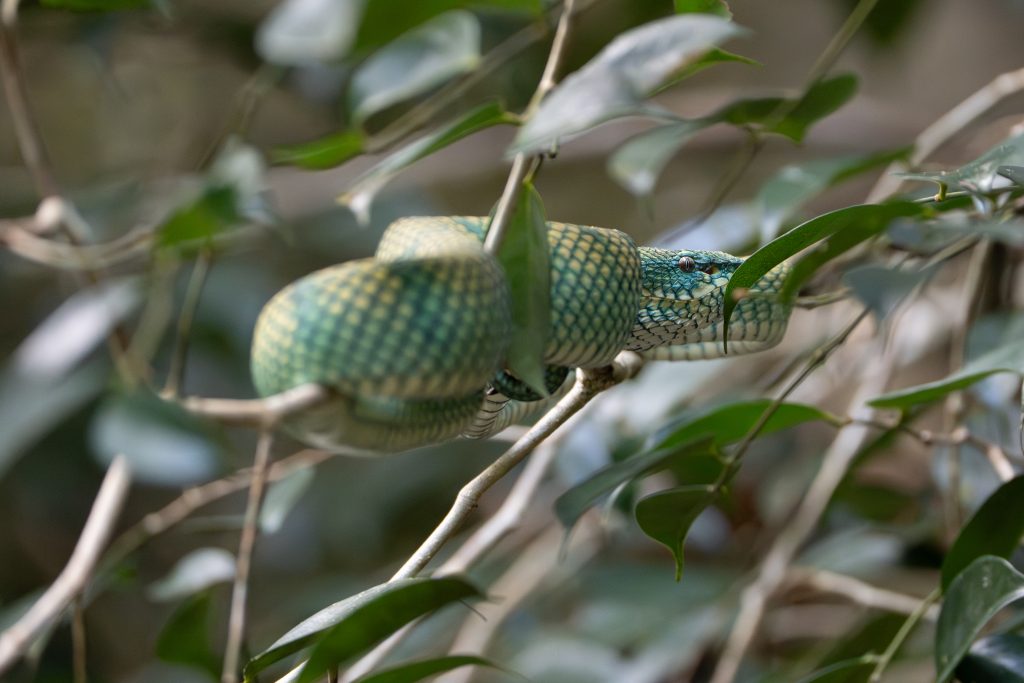
Where Does the Borneo Pit Viper Live?
The Bornean Keeled Pit Viper is distributed across Borneo, including areas of Indonesian Kalimantan, Malaysian Borneo, and Brunei. It is associated with a variety of forest habitats.
Importantly, it is not restricted to pristine lowland rainforest.
Records and observations indicate that Tropidolaemus snakes can occur in different forest environments, including areas associated with peatlands and other habitats across Borneo.
This makes the species particularly interesting in the context of Sebangau National Park, one of the most important peat-swamp forest landscapes in Central Kalimantan.
Borneo Pit Viper in Sebangau National Park
Sebangau National Park is famous internationally for its orangutans, but its biodiversity extends far beyond primates.
The park’s tropical peat-swamp ecosystem supports an impressive variety of reptiles, amphibians, birds, mammals, and insects.
A wildlife survey and conservation information from the Sebangau landscape has documented numerous snake species, including pit vipers. The Borneo Nature Foundation has specifically highlighted pit vipers among the snakes found in Sebangau National Park and explained their characteristic heat-sensing facial pits.
For visitors, this means that a trek through Sebangau is not simply an orangutan experience.
While walking along forest trails, you may encounter a variety of reptiles, including snakes resting in vegetation.
Finding a pit viper is never guaranteed, however. These snakes are masters of camouflage and can remain completely still for long periods.
What Does the Borneo Pit Viper Eat?
Borneo Pit Vipers are predators.
Members of the Tropidolaemus genus are known to feed on small vertebrates, including birds, rodents, frogs, and lizards.
Their hunting strategy is based largely on patience.
Instead of actively searching for prey, the snake can position itself on a branch and wait. When an appropriate animal approaches, the snake can strike rapidly.
This hunting strategy is particularly effective in the complex three-dimensional environment of a rainforest canopy.
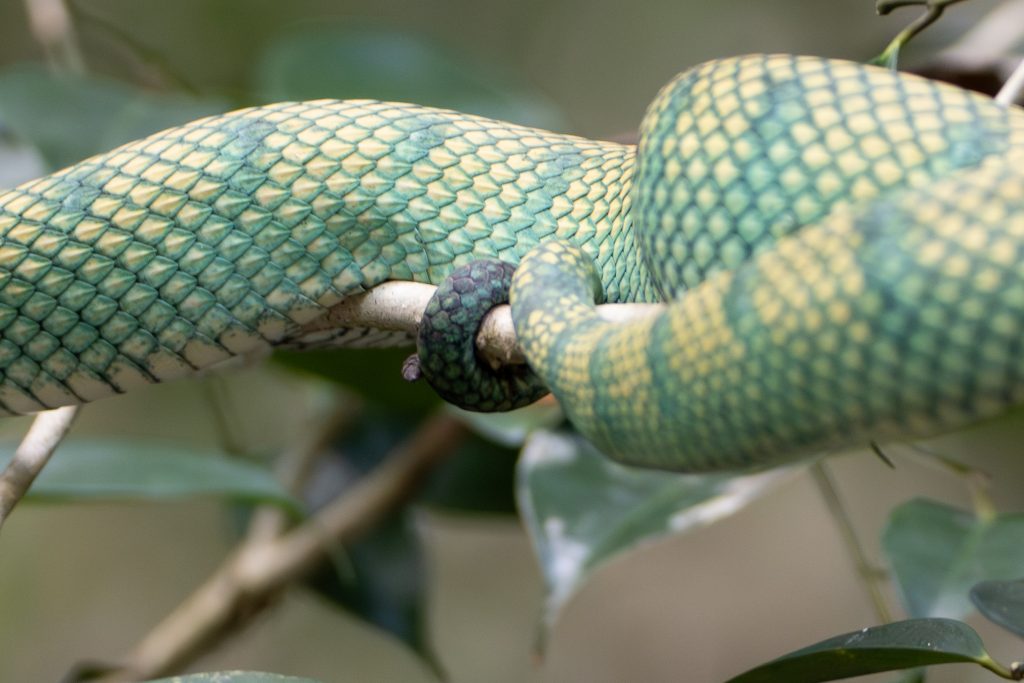
An Arboreal Snake
One of the most important things to understand about the Borneo Pit Viper is that it is primarily arboreal.
That means it spends much of its life above the ground.
Its body, scales, and tail are adapted for climbing and remaining securely positioned on branches and vegetation.
This also explains why wildlife guides may discover pit vipers in places that visitors would not normally expect to find a snake.
When walking through the forest, it is therefore important to look not only at the trail but also at the vegetation surrounding and above it.
A careful observer may discover a beautifully patterned snake resting quietly on a branch.
Are Borneo Pit Vipers Dangerous?
Yes.
The Borneo Pit Viper is a venomous snake, and it should always be treated with respect.
However, venomous does not mean that the snake is actively looking for people.
Pit vipers generally prefer to avoid unnecessary confrontation. Bites usually occur when a snake is threatened, disturbed, stepped on, touched, or handled.
Scientific literature on Tropidolaemus indicates that bites can produce local effects such as pain and swelling, although the medical significance of envenomation can vary.
For visitors to Sebangau National Park, the best approach is simple:
Do not approach, touch, corner, or attempt to handle the snake.
If a snake is encountered on the trail, give it plenty of space and allow it to remain undisturbed.
How to Photograph a Borneo Pit Viper
For wildlife photographers, a pit viper can be an incredible subject.
Its unusual colors, triangular head, keeled scales, and characteristic posture can produce striking photographs.
But photography should always come second to safety.
If you encounter a pit viper:
- Keep a safe distance.
- Do not attempt to move the snake.
- Do not use sticks or other objects to make it move.
- Avoid blocking its escape route.
- Listen to your local guide or ranger.
- Use a telephoto lens instead of moving closer.
- Never attempt to handle the snake for a photograph.
A good wildlife photograph is one where the animal remains completely undisturbed.
Why Are Pit Vipers Important to the Ecosystem?
Predators such as pit vipers play an important role in maintaining the balance of rainforest ecosystems.
By feeding on small mammals, birds, amphibians, and other animals, snakes form part of the complex food web that connects different levels of the forest ecosystem.
Their presence is also a reminder that rainforest biodiversity is much more than the species that are easiest to see.
Visitors may come to Sebangau hoping to see orangutans, but the ecosystem also contains thousands of less conspicuous species performing important ecological roles.
A snake resting quietly on a branch is one small part of this much larger system.
Borneo Pit Viper vs. Other Pit Vipers
Borneo is home to several species of venomous snakes, including different pit vipers.
This can sometimes make identification difficult for visitors.
The Borneo Pit Viper is particularly recognizable because of its distinctive coloration, broad head, arboreal lifestyle, and strongly keeled scales.
However, color alone should never be used to identify a venomous snake.
Many Bornean snakes can display green coloration, and some harmless species can resemble venomous snakes.
For this reason, visitors should avoid attempting to identify an unfamiliar snake by getting close to it.
If you see a snake in Sebangau, the safest option is to observe it from a distance and let an experienced local guide assist with identification.
When Is the Best Time to See a Pit Viper?
There is no guaranteed season for seeing a Borneo Pit Viper.
These snakes can be difficult to locate because they spend long periods resting in vegetation.
Their relatively sedentary behavior is one of the reasons they can be overlooked even in areas where they occur regularly. A study from Bako National Park in Sarawak recorded a juvenile moving less than two meters over six days and five nights.
For wildlife enthusiasts, this means that patience is essential.
The more time you spend carefully observing the forest, the greater your chances of noticing animals that are otherwise easy to miss.
A Reminder That Sebangau Is More Than Orangutans
The orangutan is undoubtedly one of Sebangau National Park’s most famous inhabitants.
But the forest is home to an extraordinary range of life.
From proboscis monkeys and gibbons to hornbills, crocodiles, frogs, insects, and snakes, every layer of the forest contributes to the ecosystem.
The Borneo Pit Viper represents one of the less frequently discussed but fascinating inhabitants of this environment.
Seeing one in the wild can be a highlight for anyone interested in herpetology and tropical biodiversity.
It also offers an opportunity to understand why rainforest conservation is so important.
Protecting the forest does not only protect charismatic animals such as orangutans. It also protects the complex communities of reptiles, amphibians, insects, plants, fungi, and microorganisms that make the ecosystem function.
Final Thoughts
The Borneo Pit Viper is one of the rainforest’s most striking predators.
With its vibrant coloration, heat-sensing pits, arboreal lifestyle, and patient ambush-hunting strategy, it is perfectly adapted to life in the forests of Borneo.
In Sebangau National Park, encountering one can be an unforgettable wildlife experience—but it is important to remember that this is a venomous wild animal.
Observe from a safe distance, never attempt to handle it, and let experienced guides help you appreciate the snake without disturbing it.
For travelers exploring Sebangau, the possibility of finding a pit viper is another reminder that every walk through the forest can reveal something unexpected.
You may enter the rainforest looking for an orangutan.
But if you slow down and look carefully, you might discover a beautifully patterned Borneo Pit Viper quietly watching the forest from a branch above.
Frequently Asked Questions About the Borneo Pit Viper
Is the Borneo Pit Viper venomous?
Yes. The Bornean Keeled Pit Viper (Tropidolaemus subannulatus) is a venomous member of the Viperidae family.
What is the scientific name of the Borneo Pit Viper?
The Bornean population is currently recognized as Tropidolaemus subannulatus. Older sources may identify Bornean individuals as Tropidolaemus wagleri because of historical differences in taxonomy.
Can you see Borneo Pit Vipers in Sebangau National Park?
Yes. Pit vipers have been recorded in the Sebangau landscape, although seeing one in the wild is never guaranteed.
Where do Borneo Pit Vipers live?
They are primarily arboreal and can occur in different forest habitats across Borneo, including areas of Kalimantan, Sabah, Sarawak, and Brunei.
What do Borneo Pit Vipers eat?
They prey on small vertebrates such as birds, rodents, frogs, and lizards.
Are Borneo Pit Vipers aggressive?
They are not generally considered animals that seek out people. Like other venomous snakes, however, they can bite when threatened, disturbed, or handled. The safest approach is always to keep your distance.
Why do pit vipers have pits on their faces?
The pits are specialized heat-sensing organs located between the eyes and nostrils. They help the snake detect warm-bodied prey.