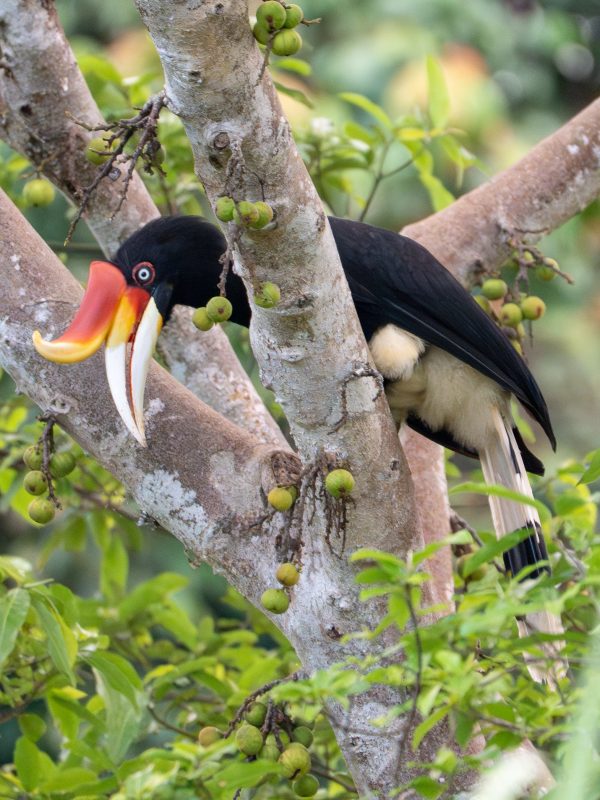
Deep within the ancient rainforests of Borneo, one bird commands attention the moment it flies overhead. With its enormous orange-red casque, powerful wings, and unmistakable call echoing through the forest canopy, the Rhinoceros Hornbill (Buceros rhinoceros) is one of the island’s most iconic wildlife species. But for the Indigenous Dayak communities of Kalimantan, this remarkable bird represents much more than biodiversity—it is a symbol of identity, spirituality, leadership, and the enduring relationship between humans and nature.
For travelers visiting Sebangau National Park or exploring Central Kalimantan, understanding the connection between the Rhinoceros Hornbill and the Dayak people offers a deeper appreciation of both the rainforest and its rich cultural heritage.
Meet the Rhinoceros Hornbill
The Rhinoceros Hornbill is among the largest hornbill species found in Southeast Asia. It inhabits primary and mature secondary forests across Borneo, Sumatra, the Malay Peninsula, and southern Thailand. Its most distinctive feature is the brightly colored casque—a horn-like structure that curves upward above its bill, giving the species its name.
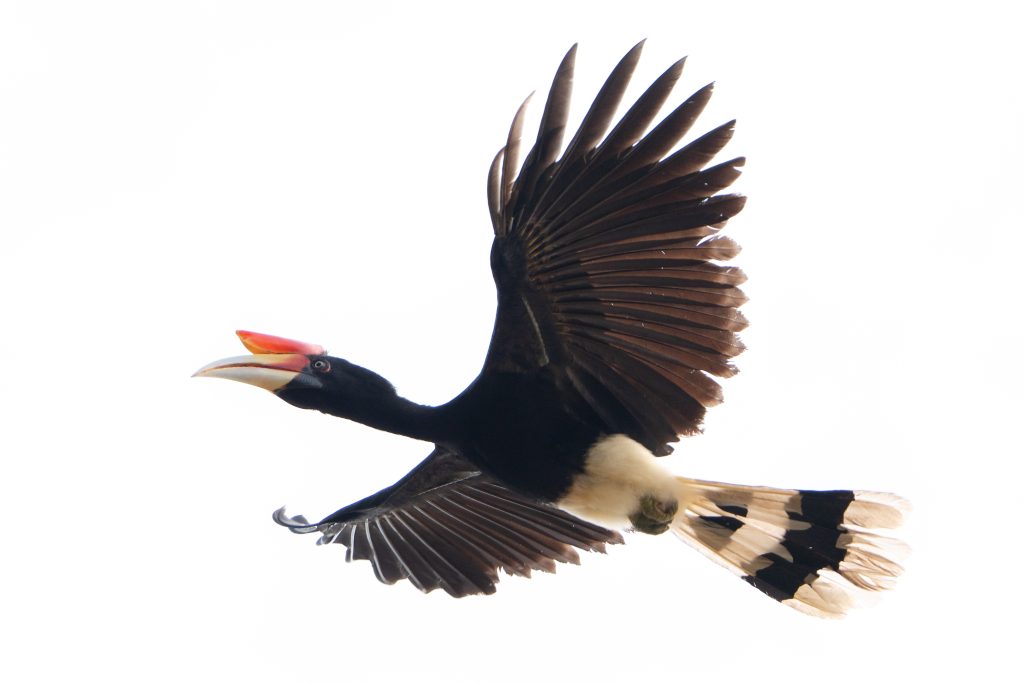
Adult birds can reach over one meter in length, with striking black plumage, white tail feathers marked by a bold black band, and vivid red, orange, and yellow colors on the bill and casque. During flight, the sound of its wingbeats can be heard from surprisingly long distances, creating an unforgettable experience for anyone lucky enough to witness one gliding above the rainforest canopy.
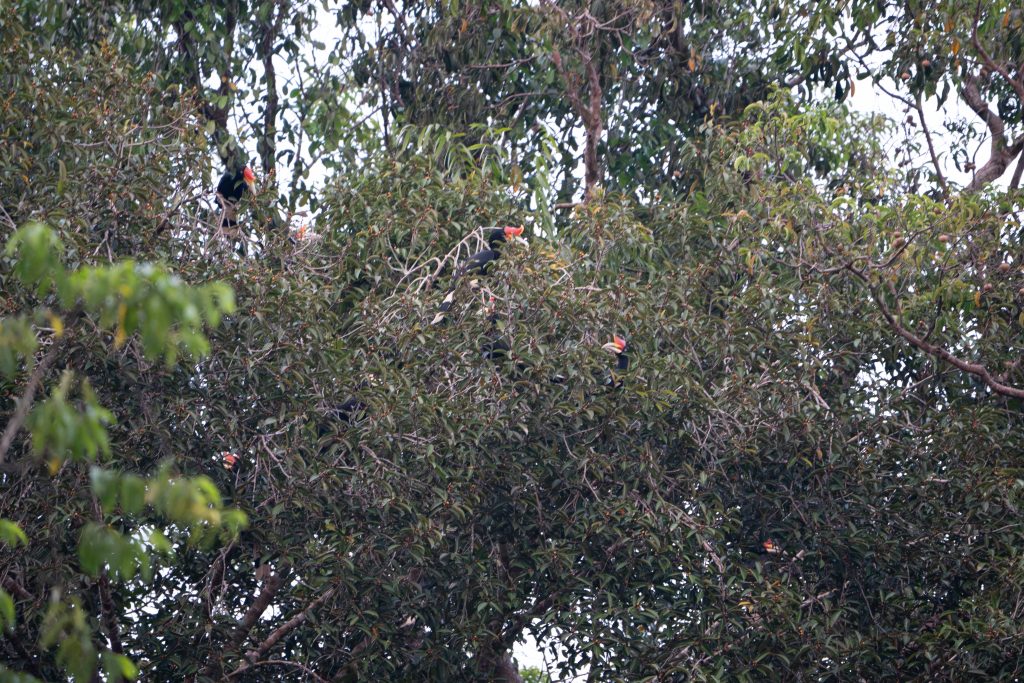
Like many hornbill species, Rhinoceros Hornbills primarily feed on fruit, especially figs, although they also consume insects, reptiles, and small animals when available. Their feeding habits make them one of the rainforest’s most important seed dispersers, helping regenerate forests by carrying seeds across vast distances. Without hornbills, many tree species would struggle to reproduce naturally.
A Sacred Symbol in Dayak Culture
For countless generations, the Dayak peoples of Borneo have regarded the Rhinoceros Hornbill—known locally as Burung Enggang—as one of the most sacred animals in their culture.
Across different Dayak ethnic groups, the hornbill symbolizes:
- Nobility and leadership
- Courage and strength
- Harmony between humans and nature
- Connection between the earthly and spiritual worlds
Although traditions vary among the many Dayak communities, the hornbill is commonly viewed as a respected messenger or spiritual being associated with the upper world. Its ability to soar high above the forest canopy made it a natural symbol linking the heavens with life on earth.
Unlike many modern symbols that are purely decorative, the hornbill carries living cultural significance. It appears in oral traditions, ceremonies, carvings, textiles, architecture, and ceremonial clothing throughout Borneo.
The Hornbill in Dayak Art and Architecture
Visitors to Kalimantan quickly notice hornbill imagery almost everywhere.
Traditional longhouses often feature carved hornbill motifs along roof beams and entrances. Wooden sculptures portray the bird with its distinctive casque, while intricate beadwork and woven fabrics incorporate stylized hornbill designs.
The bird’s elegant shape also appears on:
- Traditional shields
- Ceremonial costumes
- Dance performances
- Handcrafted jewelry
- Tattoo designs
- Cultural festivals
These artistic representations are not merely decorative—they express respect for ancestral traditions and the close relationship between the Dayak people and the rainforest that sustains them.
Traditional Ceremonies and Respect for the Hornbill
Historically, hornbill feathers were used in ceremonial attire worn during important cultural events. Their graceful appearance made them symbols of prestige and honor.
However, traditions have evolved significantly. Today, many Dayak communities actively support wildlife conservation and increasingly use preserved heirloom feathers, legally obtained materials, or artificial substitutes during cultural performances to reduce pressure on wild bird populations.
This shift reflects an important balance between preserving cultural identity and protecting endangered wildlife for future generations.
Guardians of the Rainforest
The relationship between the Dayak people and the Rhinoceros Hornbill goes beyond symbolism.
For centuries, Indigenous communities have depended on healthy forests for food, medicine, clean water, and cultural survival. Because hornbills rely on large old-growth trees for nesting, their presence signals a healthy rainforest ecosystem.
Female Rhinoceros Hornbills nest inside natural tree cavities, sealing themselves inside with mud, fruit pulp, and droppings, leaving only a narrow slit through which the male delivers food for several months while she incubates eggs and raises the chicks.
This extraordinary nesting strategy means hornbills depend heavily on giant mature trees—exactly the trees most threatened by logging and habitat destruction.
Conservation Challenges
Despite their cultural importance, Rhinoceros Hornbills face growing threats across Borneo.
Major challenges include:
- Deforestation
- Illegal logging
- Habitat fragmentation
- Forest fires
- Hunting for feathers or ornamental casques
Because hornbills reproduce slowly—typically raising only one or two chicks per breeding season—population recovery takes many years. The loss of nesting trees has become one of the greatest threats to their long-term survival.
Fortunately, national parks such as Sebangau National Park protect extensive areas of suitable habitat, while conservation organizations work alongside local communities to safeguard both forests and wildlife.
Spotting Rhinoceros Hornbills in Sebangau National Park
Sebangau National Park is best known for its wild orangutans, but patient visitors may also encounter several hornbill species, including the Rhinoceros Hornbill.
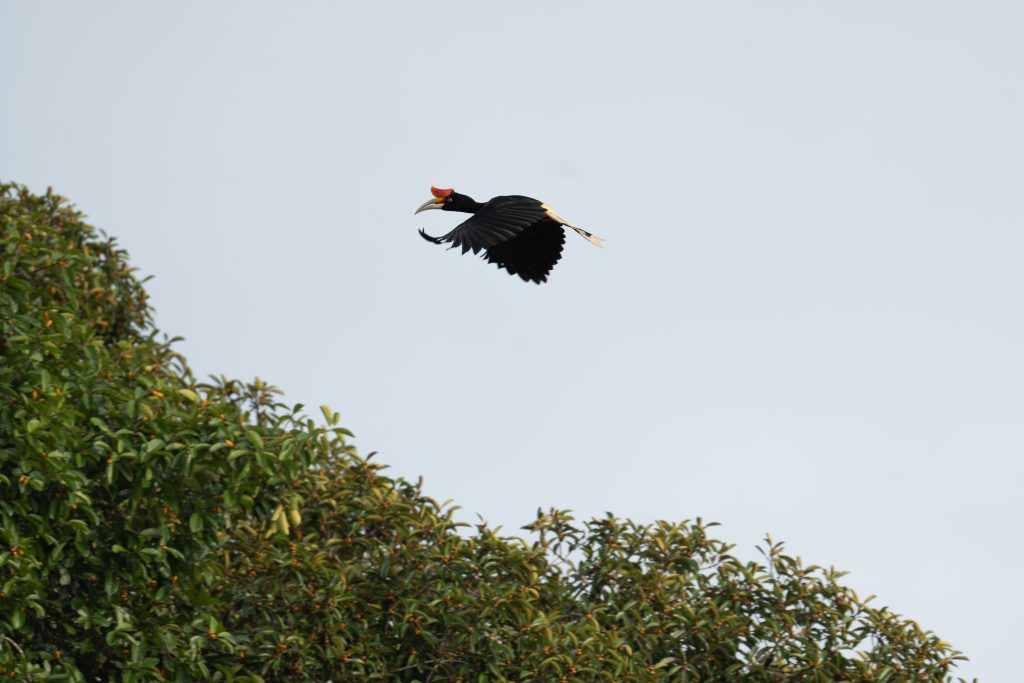
The best opportunities occur during early morning river cruises or guided jungle treks when hornbills travel between fruiting trees. Experienced local guides can often identify them by their loud wingbeats before the birds even come into view.
Watching a Rhinoceros Hornbill fly across the forest canopy is one of the unforgettable highlights of a Borneo wildlife adventure.
More Than a Bird
The Rhinoceros Hornbill reminds us that conservation is not only about protecting wildlife—it is also about preserving cultures that have lived alongside these species for generations.
For the Dayak people, the hornbill embodies wisdom, courage, and the spiritual connection between humans and the forest. For scientists, it is a keystone species essential to rainforest regeneration. For visitors, it becomes a powerful symbol of Borneo’s extraordinary natural and cultural heritage.
When you hear the thunderous wingbeats of a Rhinoceros Hornbill echoing through the rainforest of Central Kalimantan, you are witnessing more than an impressive bird. You are experiencing a living symbol that has united nature, tradition, and community for centuries.
Whether you come to Sebangau National Park in search of orangutans, exotic birds, or authentic Dayak culture, the Rhinoceros Hornbill offers a story that captures the true spirit of Borneo—where wildlife and Indigenous heritage continue to shape one another in one of the world’s oldest rainforests.